

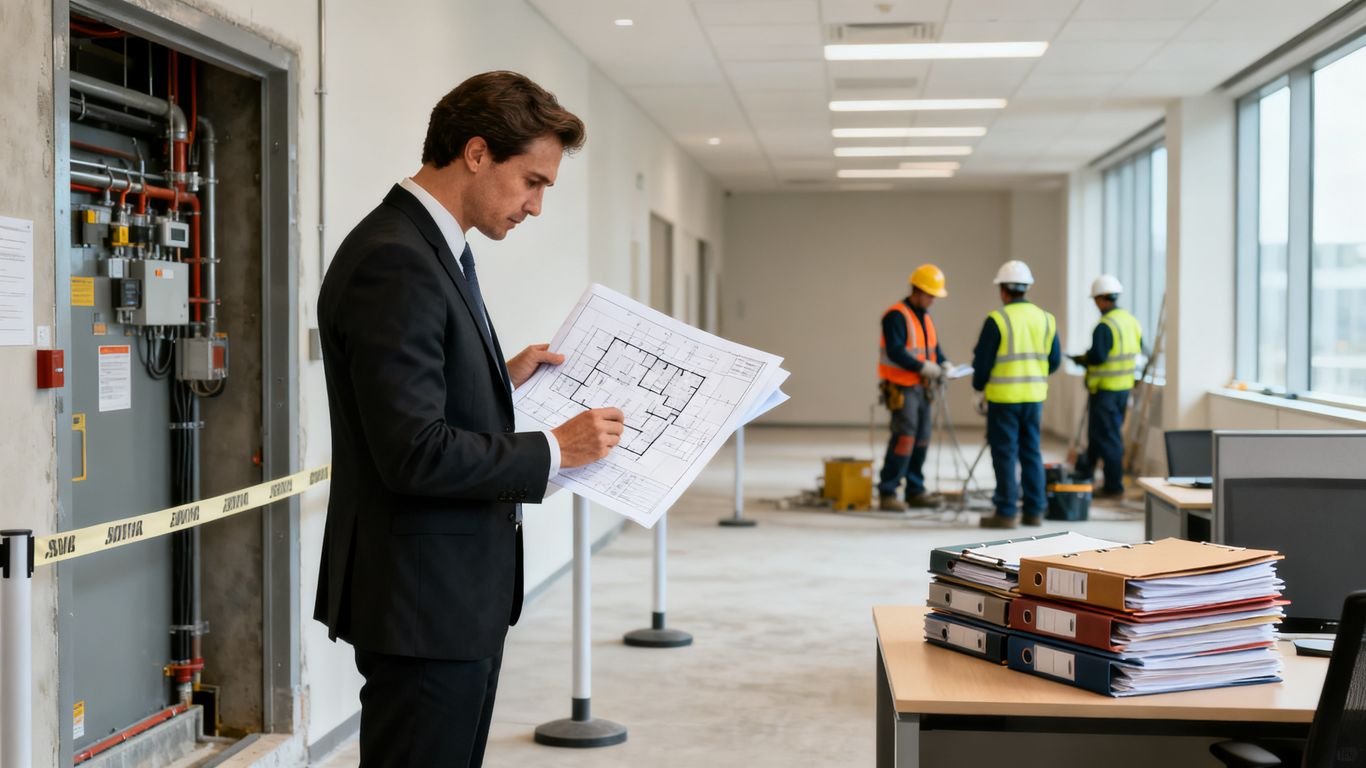
Commercial property asbestos exposure is a management issue as much as a construction issue. A building can appear clean and well maintained while older materials remain behind walls, above ceilings, or around mechanical systems. Property managers protect tenants by understanding where asbestos may exist, preventing disturbance, and coordinating qualified assessments whenever work could affect suspect materials.
Where asbestos may be present in commercial buildings
Asbestos-containing materials may occur in insulation around boilers, pipes, ducts, and tanks; sprayed fireproofing; acoustic or decorative plaster; floor tiles; roofing products; cement panels; and some adhesives. Materials installed during different renovations may vary from room to room, so a visual assumption about one area should not be applied to the entire building. A useful overview of common locations and health concerns appears in this asbestos in buildings resource.
The presence of asbestos does not automatically mean that occupants are being exposed. Risk increases when a material is damaged, deteriorated, or disturbed in a way that can release fibers into the air. Concealed materials still matter because future drilling, leaks, ceiling work, or demolition can bring them into contact with workers and tenants.
How asbestos exposure occurs during normal operations
Routine operations can disturb suspect material in surprisingly ordinary ways. A maintenance employee may drill through a wall, replace a light fixture, open a ceiling, repair a pipe, or sand a floor without realizing that asbestos-containing material is nearby. Water damage, vibration, impact, and air movement can also affect materials that were previously stable.
Construction and maintenance personnel may face greater exposure potential because their work brings them close to insulation, fireproofing, and wall or ceiling systems. Property managers should therefore treat work orders as exposure-control decisions, not merely scheduling tasks. Before work begins, the relevant survey and management records should be checked and the work method reviewed.
The roles of property owners, managers, employers, and tenants
The owner generally provides the building-wide framework for identifying and managing asbestos, while the property manager turns that framework into daily practice. Employers control the safety of their own employees, including contractors they direct, and tenants must follow building rules and report damage or planned alterations. Responsibilities should be written into leases, vendor agreements, work permits, and emergency procedures rather than left to informal understanding.
A manager also serves as the connection between parties that may not share the same information. Tenants may know about a leak, contractor, or proposed fit-out before the building team does. Prompt reporting and clear escalation routes help prevent a small maintenance request from becoming an uncontrolled disturbance.
Key OSHA, EPA, state, and local requirements
Federal rules can apply differently depending on the activity, building type, material, and people performing the work. OSHA requirements address worker protection, while EPA requirements can govern renovation, demolition, emissions, notifications, waste handling, and professional accreditation. State and local authorities may impose additional training, licensing, notification, or work-practice requirements.
The EPA’s guidance for renovation and demolition requirements is a useful starting point for understanding federal expectations, but it is not a substitute for a project-specific legal and technical review. Managers should confirm current requirements with the relevant agencies and qualified asbestos professionals before authorizing regulated work. A compliance file should identify who made that determination and when.
Identify asbestos-containing materials before they are disturbed
The safest time to address asbestos is before a worker opens a wall or removes a ceiling. Identification requires more than relying on a building’s age or a previous owner’s recollection. A documented survey, condition assessment, and process for reviewing proposed work give managers a defensible basis for protecting tenants and contractors.
Reviewing building age, records, and renovation history
Start with construction dates, original specifications, architectural drawings, maintenance files, prior surveys, abatement records, and permits. Renovation history is particularly valuable because a newer finish may conceal older insulation, adhesive, plaster, or fireproofing. Records should be compared with current conditions rather than accepted as complete without verification.
Missing records should be treated as uncertainty, not proof that asbestos is absent. The review should also identify inaccessible voids, tenant improvements, mechanical rooms, shafts, and areas where materials may have been replaced only in part. This information helps the consultant design a survey that reflects the building as it exists today.
Conducting an asbestos survey and assessing material condition
A qualified inspector can identify suspect materials, collect samples where appropriate, and document locations, quantities, accessibility, and condition. The survey should cover areas that workers may enter or disturb, including concealed spaces that will be opened during planned construction. Laboratory analysis and professional interpretation are needed before a manager relies on a material’s status.
Condition is as important as presence. A sealed, intact material may be managed in place, while a damaged or friable material may require prompt controls and professional attention. The report should be clear enough for a maintenance coordinator to match a work order to a specific location, material, and required precaution.
Prioritizing accessible, damaged, or friable materials
Not every identified material requires immediate removal. Priority usually belongs to materials that are damaged, friable, exposed to frequent contact, located near air movement, or likely to be affected by planned maintenance. A practical risk ranking considers condition, accessibility, likelihood of disturbance, occupancy, and the consequences of a release.
Managers can use a written priority register to focus limited resources. It should identify immediate controls, responsible parties, target dates, and the professional input needed for each item. This approach keeps attention on actual exposure pathways instead of treating every material as equally urgent.
Updating surveys after alterations, repairs, or changes in use
A survey is a living management document. New tenant improvements, water intrusion, mechanical replacements, fire damage, and changes in occupancy can reveal materials that were not previously accessible or can change the way a known material is used. The management plan should require a survey review before work is approved.
Updated drawings, photographs, sample results, abatement documents, and clearance records should be added to the central file. If a project exposes an unexpected material, work should pause until a qualified person evaluates it. Future managers and contractors then inherit reliable information rather than a collection of disconnected project memories.
Create an asbestos management and protection plan
An asbestos management plan converts survey findings into repeatable building practices. It should explain what is present, where it is located, how it is labeled, who may work near it, and what happens if its condition changes. The plan works best when it is integrated with work-order approval, vendor onboarding, emergency response, and tenant communication.
Establishing an operations and maintenance program
An operations and maintenance program generally focuses on controlling known or presumed asbestos-containing materials while they remain in the building. It may include labeling, restricted access, periodic inspections, approved work methods, housekeeping rules, response procedures, and documentation. The EPA describes operations and maintenance guidance alongside federal renovation and demolition information in its building asbestos management guidance.
The program should be practical for the people who use it. A maintenance worker needs to know how to check a location, stop a task, and contact the right person without searching through an unwieldy manual. Work permits and service tickets can create a simple checkpoint: no disturbance until the material status and controls are confirmed.
Assigning responsibilities to staff and qualified professionals
The plan should name the person responsible for maintaining the asbestos records and the person authorized to approve work near suspect materials. It should also distinguish duties that building staff can perform from those requiring an accredited inspector, management planner, project designer, air-monitoring professional, or abatement contractor. Titles alone are not enough; assignments should include contact details and backup coverage.
Vendor contracts should require compliance with applicable regulations and building procedures. Contractors should provide qualifications, work plans, notifications, waste records, and clearance documentation when relevant. Clear responsibility prevents the common failure in which each party assumes another party checked the material.
Setting inspection schedules and response procedures
Inspection frequency should reflect material condition, accessibility, building activity, and prior incidents. More frequent review may be appropriate for exposed or vulnerable materials, areas with recurring leaks, and spaces undergoing frequent maintenance. Each inspection should record changes rather than merely confirm that someone visited.
Response procedures should cover damage, suspected releases, water intrusion, unauthorized work, and tenant complaints. They should identify who isolates the area, who calls a qualified professional, how occupants are informed, and what evidence must be preserved. Practiced procedures are easier to follow when an event is stressful.
Maintaining required records and tenant access to information
The central file should hold surveys, sample results, diagrams, inspection notes, notifications, training records, contractor credentials, work plans, waste documentation, air-monitoring reports, and clearance results. Version control matters because an outdated floor plan can be more dangerous than no plan if it sends a worker to the wrong location.
Tenants do not necessarily need every technical document, but they do need timely information relevant to their spaces and activities. The plan can provide a contact route, explain how work is reviewed, and make appropriate records available through a controlled process. Consistent access builds confidence without exposing sensitive building information unnecessarily.
Reduce tenant exposure during everyday building operations
Everyday building operations create the most frequent opportunities for prevention. A manager can reduce risk by controlling access, screening work orders, coordinating vendors, and keeping tenants away from areas where materials may be damaged or disturbed. These measures are most effective when they are routine rather than introduced only after a complaint.
Controlling access to damaged or suspect materials
Damaged ceilings, pipe insulation, wall surfaces, and fireproofing should be protected from contact until they are assessed. Barriers, temporary closures, warning labels, and alternate routes may be appropriate, but they should not be installed in a way that spreads debris or interferes with emergency egress. A sign alone cannot control a material that is accessible from a busy corridor.
The manager should record the condition, restrict unnecessary entry, and arrange qualified evaluation. Tenants should know which areas are unavailable and whom to contact if they observe additional damage. Controls should be revisited after leaks, impacts, or changes in building use.
Managing cleaning, drilling, repairs, and maintenance work
Cleaning crews and maintenance staff should not sweep, brush, sand, cut, drill, or otherwise disturb suspect material without an approved method. Work orders should identify the exact location and scope, then route tasks through the asbestos management process before tools arrive on site. Routine tasks near known materials may require specific procedures even when the job seems minor.
A useful work-order review asks four basic questions before scheduling begins:
- Could the task disturb a wall, ceiling, floor, insulation, roofing, or fireproofing material?
- Has the relevant area been surveyed and matched to current drawings?
- Does the assigned worker or contractor have the required training and authorization?
- What isolation, notification, cleanup, and documentation will the task require?
This short review makes exposure prevention part of ordinary maintenance administration. It also gives the property manager a record showing why the task was approved, modified, or referred to a qualified professional.
Using proper work practices and protective equipment
Work practices must be selected for the material and task, not copied from a generic checklist. Depending on the activity, controls may include isolation, wet methods, restricted access, specialized tools, protective clothing, respirators, decontamination, and controlled waste handling. Only trained and properly authorized personnel should perform regulated asbestos work.
Protective equipment is not a replacement for planning or containment. Managers should verify that the employer or contractor has assessed the work, selected suitable controls, and met applicable respiratory protection and training requirements. Occupants should remain outside the work area unless their presence has been specifically evaluated and permitted.
Training employees, vendors, and building service providers
Training should cover recognition of suspect materials, the building’s stop-work rule, reporting routes, prohibited activities, emergency contacts, and the difference between ordinary housekeeping and asbestos-related work. It should reach engineers, porters, security staff, cleaners, tenant-improvement coordinators, and outside service providers. New workers need orientation before they receive access, not after an incident.
Short refreshers tied to real building conditions can be more useful than abstract instruction. A photograph of a pipe chase, ceiling system, or damaged panel can help staff recognize where the plan applies. Attendance, course content, and qualification records should be retained with the management file.
Manage construction, renovation, and demolition safely
Construction and demolition require a higher level of coordination because they can disturb concealed materials across a large area. The owner, manager, designer, general contractor, tenants, and regulators may all have connected duties. Work should not begin merely because a contractor has provided a price and schedule; asbestos review belongs in the project’s earliest planning decisions.
Completing a pre-construction asbestos assessment
Before design is finalized, the project team should compare the scope of work with current survey information and determine whether additional inspection or sampling is needed. The assessment should cover demolition limits, penetrations, ceiling spaces, mechanical routes, structural systems, and temporary work. If the scope changes, the asbestos review should change with it.
Project documents should state what is known, what remains inaccessible, and what happens if suspect material is discovered. This prevents the contractor from treating an incomplete survey as permission to proceed. It also allows cost, schedule, tenant relocation, and regulatory requirements to be considered before crews mobilize.
Selecting accredited inspectors and qualified abatement contractors
Selection should be based on current credentials, relevant experience, insurance, written procedures, and the ability to meet applicable federal, state, and local requirements. The parties should verify that inspectors, project designers, supervisors, workers, and air-monitoring professionals hold the qualifications required for the work. Accreditation expectations can vary by jurisdiction and project type.
The owner should request a detailed scope, containment approach, worker-protection plan, waste method, monitoring plan, and closeout package. Lowest price alone is a poor measure of suitability when an error can affect occupied space and create substantial cleanup or delay. Contracts should also define stop-work authority and communication responsibilities.
Separating occupied areas from regulated work zones
Occupied areas should be separated from regulated work through designed barriers, controlled entry, pressure management where required, and clear routes for workers and waste. The project team must consider shared air systems, elevators, loading areas, fire exits, restrooms, and neighboring tenants. A barrier that looks complete may still fail if building systems create an unrecognized pathway.
Tenant relocation or temporary closure may be necessary when separation cannot reliably control exposure. Security and building staff should know who may enter the work zone and how to respond to an alarm, breach, or unauthorized access. These details should be tested during pre-work coordination rather than improvised during demolition.
Coordinating schedules, notifications, air monitoring, and clearance
A safe project schedule includes regulatory notifications, tenant notices, mobilization, containment setup, work, monitoring, cleaning, inspection, and clearance. Notifications should be issued within the applicable timeframes and should identify what occupants need to do, where they can obtain updates, and whom they can contact. Air monitoring and clearance arrangements should be made before work begins.
Work is not complete when visible removal ends. The qualified project team must complete the required inspection, cleaning, monitoring, and documentation before the area returns to normal use. The manager should collect the closeout package and update building records before closing the project.
Respond to suspected asbestos damage or exposure incidents
An incident may begin with a broken ceiling panel, a maintenance mistake, a leak, or an unexplained complaint about dust. The immediate objective is to prevent further disturbance while obtaining qualified advice. Managers should avoid making health conclusions on site and focus first on controlling the area, preserving information, and communicating accurately.
Recognizing signs of disturbance and potential release
Potential warning signs include crumbling or delaminated material, fallen insulation, damaged sprayed fireproofing, debris after an impact, unplanned dust from drilling, or work that reveals an unlisted material. Water intrusion and mechanical vibration can also change the condition of previously stable material. A concern should be escalated even when no visible fibers are present, since asbestos fibers cannot be reliably identified by sight.
Staff should note what happened, when it happened, who may have been nearby, and whether ventilation or cleaning occurred afterward. They should not collect loose material or attempt to investigate by touch. Prompt, careful observations help the qualified responder decide what controls and evaluations are needed.
Isolating the area without spreading contamination
The first response should be to stop the activity and keep people out of the affected area. Doors should remain closed where possible, and staff should avoid sweeping, vacuuming with ordinary equipment, moving debris, or walking through the area unnecessarily. Building systems should be managed only by people who understand the potential for air movement and have appropriate direction.
Isolation must not create a second hazard by blocking emergency exits or trapping occupants. Security, facilities, and emergency personnel should receive a concise description of the area and the concern. A qualified asbestos professional should determine sampling, cleaning, containment, and reoccupation steps.
Notifying tenants and contacting qualified responders
Communication should be prompt, factual, and proportionate. Tenants in or near the affected area should be told what access restrictions apply, what actions to avoid, how updates will be delivered, and where to direct questions. Speculation about exposure or health outcomes can create confusion and should be avoided until qualified professionals evaluate the event.
The manager should contact the designated asbestos consultant, employer representatives, building owner, and relevant authorities as required. If anyone has an urgent medical concern, the person should be directed to appropriate medical or emergency services. Operational urgency is not a reason to bypass qualified assessment.
Documenting incidents, evaluating exposure, and arranging follow-up
An incident file should include the initial report, photographs taken without disturbing the area, work orders, access records, witness accounts, notifications, professional recommendations, monitoring results, cleanup documents, and clearance records. The file should distinguish observed facts from assumptions. This makes later evaluation more reliable and supports improvements to the management plan.
Exposure evaluation is a professional determination based on the circumstances, materials, duration, controls, and available evidence. Follow-up may include additional inspection, medical or occupational-health guidance, tenant assistance, and a review of contractor performance. The area should not reopen until the responsible qualified parties confirm that the required conditions have been met.
Communicate transparently with tenants and improve controls
Tenants are more likely to cooperate when building management explains what is known, what is being checked, and what behavior is expected. Communication should neither minimize asbestos nor present every identified material as an immediate emergency. A consistent message, supported by records and qualified advice, helps protect health while preserving trust.
Explaining asbestos risks without creating unnecessary alarm
A clear explanation distinguishes between asbestos being present and fibers being released. Tenants should understand that disturbance, damage, and work practices influence risk, and that the building has procedures for controlling those conditions. Plain language is preferable to technical terminology that sounds reassuring or frightening without explaining what occupants should do.
Managers should acknowledge uncertainty when an assessment is still underway. They can explain the temporary controls, the expected next step, and the time of the next update without making unsupported promises. The goal is informed cooperation, not reassurance at any cost.
Providing notices for inspections, repairs, and abatement
Advance notices should state the location, purpose, dates, expected noise or access effects, and contact information. For abatement or regulated work, notices should also explain boundaries, relocation arrangements, ventilation or access restrictions, and the conditions for reopening. Information should be delivered through channels tenants actually monitor, with alternative formats available when needed.
Last-minute work still deserves a notice, even if the message is brief. A notice that explains a delay or precaution is usually better than unexplained barriers and rumors. After work, management should communicate completion and identify where relevant documentation can be reviewed.
Handling tenant questions, complaints, and accommodation requests
A designated contact should log questions and route technical issues to the qualified professional rather than offering an improvised interpretation. Complaints should be acknowledged, investigated, and answered with the facts available at the time. Records should show the question, response, action taken, and any promised follow-up.
Some tenants may request schedule changes, temporary relocation, or other accommodations because of health concerns, disability, pregnancy, or anxiety. Requests should be handled respectfully and through the applicable accommodation process, with privacy protected. A manager can be both careful and humane without making medical judgments.
Reviewing incidents, inspection results, and plan effectiveness
The management plan should be reviewed after incidents, renovation projects, changes in staffing, recurring tenant complaints, and inspection findings. Review questions might include whether the work-order screen was used, whether contractors received the right information, whether tenants understood the notice, and whether barriers or records failed in practice. The review should lead to a specific correction, owner, and completion date.
Periodic review also provides an opportunity to compare the plan with current regulations and building conditions. Historical research on asbestos in public and commercial buildings, including discussion of airborne levels and management strategies, is available in this public-building asbestos report. A property manager who treats the plan as a working control system—not a binder on a shelf—can steadily reduce opportunities for commercial property asbestos exposure.